
Warehouse Safety Checklist Before Operations Begin: A Complete Guide
Warehouse safety starts long before the first pallet moves for the day. At facilities across Sharjah’s industrial zones, supervisors walk the floor before machines power on, checking aisles, exits, and chemical storage points for anything out of place. A five minute walk through can catch a problem that a rushed shift start would miss entirely. Most incidents that end up in an inspection report trace back to something that sat unnoticed since the previous shift, a leaking drum, a blocked exit, or a cabinet door left unlatched overnight.
Table Of Contents:

What Hazards Should Be Identified Before a Warehouse Shift Begins?
Hazard identification is the first real task of the day, not a box to tick after the forklifts are already moving. A proper walk through covers blocked aisles, damaged racking, oil residue on the floor, and lighting that has gone dim near loading bays. Workers handling chemicals need clear sightlines to safety data sheets and storage cabinets, since a missed label or an unmarked container turns a routine task into a real hazard. OSHA’s warehousing hazard guidance notes that hazard communication failures remain among the most frequently cited issues in the sector, a reminder that floor checks matter as much as paperwork. Slip hazards near loading bays, damaged pallets stacked past a safe height, and forklift lanes that cross pedestrian walkways without marked separation all belong on the same list, since each one is easy to fix once someone actually spots it.
Warehouse Safety Around Chemical Storage
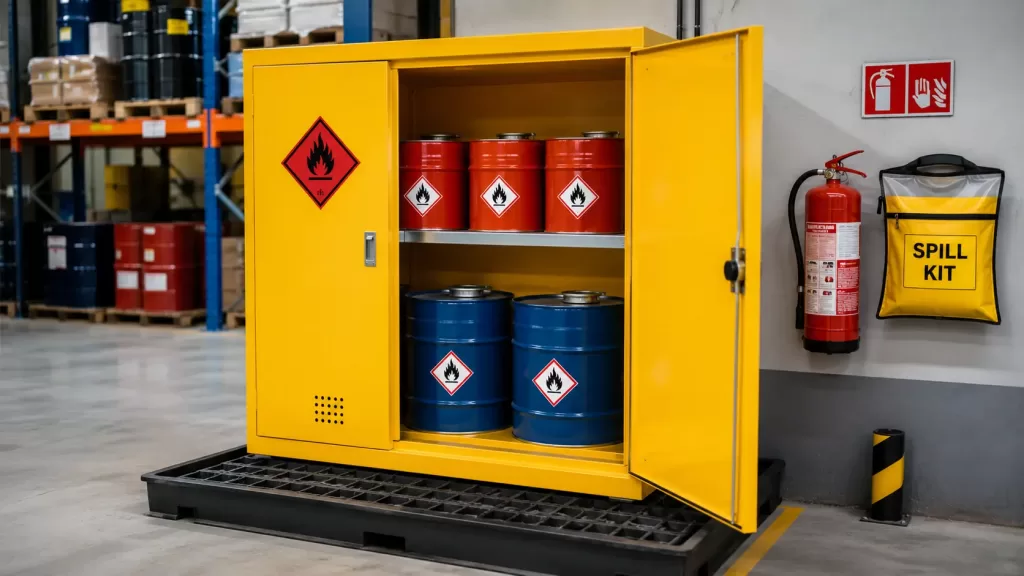
Warehouse safety around chemical storage depends on cabinets and containment systems built for the materials on site, not generic shelving repurposed for flammables. Corrosive and flammable liquids need cabinets rated for the volume and class of chemical stored, positioned away from ignition sources and forklift traffic lanes. Spectrum Lines supplies safety storage cabinets built for this exact purpose across UAE facilities, sized for everything from small maintenance stores to full production lines. Drip trays placed under drums and dispensing points catch the small leaks that never make it into an incident report but still leave residue on the floor. A cabinet without a drip tray underneath is only doing half the job it was bought for. Labeling matters just as much as containment. A drum with a faded or missing GHS hazard label forces a worker to guess at what they are handling, and guessing is how the wrong absorbent ends up on the wrong spill.
Lockout and Tagout Before Maintenance Starts
Lockout and tagout procedures come before any technician touches a conveyor, compactor, or packaging line scheduled for repair. Isolating energy sources, whether electrical, hydraulic, or pneumatic, prevents the kind of accidental startup that turns routine maintenance into a serious injury. Spectrum Lines stockslockout and tagout systems built to ANSI and ISO standards, covering everything from padlocks to circuit breaker lockouts. A written procedure only works if the person applying the lock actually understands which energy source they are isolating and confirms it before starting work. Skipping that verification step is where most lockout failures happen, not in the hardware itself. Refresher training on lockout procedures tends to get pushed aside during busy periods, which is exactly when a rushed technician is most likely to skip a step they know by heart but forgot to apply that day.
Equipment and Signage Checks Before the First Shift
Forklift operators run a pre operation check before the ignition turns, covering brakes, forks, warning horns, and tire condition, a habit tied directly to lower incident rates in distribution centers. Emergency exit routes need to stay clear of pallets and stacked inventory, not just on paper but on the actual floor at seven in the morning. Fire extinguishers mounted near loading bays and chemical storage require a visible inspection tag showing the last service date, since an expired extinguisher is functionally the same as having none at all. Floor markings, aisle signage, and hazard labels fade under UAE heat and dust faster than most facilities expect, so a quarterly repaint or relabel keeps instructions legible when someone actually needs them. Fire extinguisher classes matter here too, since a water based unit near a chemical storage area does nothing against a flammable liquid fire and can make things worse.
Spill Containment and Emergency Response Readiness
Final Thoughts
FAQ
Every single shift, not just once a week. A five minute walk covering aisles, chemical storage, and exits catches problems before they turn into incidents. Facilities that only run checks during scheduled audits tend to miss the small changes that happen daily, like a drum moved too close to a walkway.
Absorbent socks and pads, neutralizing granules, waste disposal bags, and a set of gloves and goggles sized for the chemical on site. The exact mix depends on whether the spill is oil based, chemical, or mixed waste, so matching the kit to the actual risk matters more than buying the biggest one available.
Because a machine that looks off can still hold stored energy in a hydraulic line or a capacitor. Isolating every energy source and confirming it before work starts is what actually prevents injury, not just switching off the main power and assuming the job is done.
Yes, if flammable or corrosive materials are stored on site regardless of the facility's size. A smaller warehouse just needs a smaller rated cabinet, not a lower standard of containment. The chemical class determines the requirement, not the square footage of the building.
Rarely, and it's a commonly cited gap during safety reviews. A written plan paired with visible labeling and staff training tends to matter more than the equipment itself, since untrained staff can misuse even a well stocked kit.