
Can Super Absorbent Powder Actually Stop a Grease Spill?
Grease hits the floor, and it moves. Fast. It spreads under equipment, finds every crack, and turns a manageable situation into a slip hazard within minutes. The usual response is a mop and a lot of paper towels, which mostly just smear it around. What you need is something that stops the liquid in its tracks rather than pushing it somewhere else. Super absorbent powder does exactly that, but only if you pick the right type for what you are dealing with. Get the product wrong and you are spreading the problem, not solving it.
Table Of Contents:
| SL No | Contents |
|---|---|
| 1 | What Super Absorbent Powder Actually Does |
| 2 | Final Thoughts |
| 3 | FAQ |
What Super Absorbent Powder Actually Does
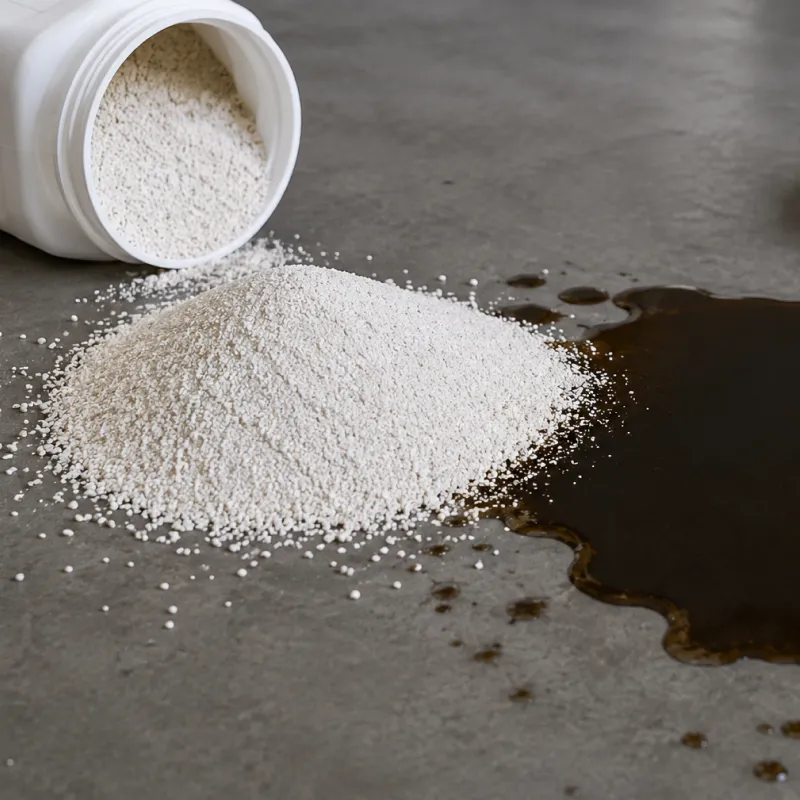
This is not talcum powder. Super absorbent powder is a granular polymer product that reacts chemically with liquid on contact. Instead of soaking the liquid up the way a cloth does and then releasing it again when you squeeze, the polymer encapsulates the fluid and forms a gel-like solid. That solid does not pour back out. You can pick it up, sweep it, and scoop it. The spill is immobilized.
The volume barely changes. A quality super absorbent powder that absorbs 100 times its own weight in liquid does not expand into a massive pile of wet material. Disposal volume stays low, which matters when you are dealing with hazardous waste handling in a regulated environment.
The key thing most facilities miss is that not all super absorbent powders work on all liquids. Oil-specific formulations are hydrophobic. They absorb petrochemical liquids, motor oil, diesel, hydraulic fluid, lubricating grease, and transmission fluid, and they repel water. Put an oil-specific powder on a water-based coolant spill, and it does nothing useful. Universal absorbent granules cover a broader range, but they do not perform as well on heavy petroleum-based spills as an oil-specific product does.
Why Grease Is a Harder Problem Than Water
Water spills have urgency but not much complexity. Grease is different. The viscosity slows everything down. It coats surfaces rather than soaking into them. It is stubborn to remove even after you have dealt with the bulk of the spill, and it makes the floor dangerous long after it looks clean.
Standard clay granules, the type that have been used in workshops for decades, absorb some grease but they do not encapsulate it. Sweep up clay granules after a grease spill and you still have oily residue left on the floor. The granules held some liquid, but the surface below is still contaminated.
The polymer-based super absorbent powder pulls the grease into itself and holds it there. The floor underneath comes up cleaner because the polymer draws the liquid away from the surface rather than just covering it. Spectrum Lines GCC stocks the Spill Kill Oil range for exactly this application. It is formulated specifically for petrochemical-based liquids and gels them into a solid that can be incinerated to less than two percent ash, which keeps disposal straightforward.
The Right Way to Use It
Application is not complicated, but sequence matters. If the spill is spreading, contain it first. Absorbent powder works on a contained spill. Pouring powder on a spill that is still flowing across a large area uses the product without stopping the movement. Booms, barriers, or even a sweep of dry sand around the perimeter to slow the spread buys you time to apply the powder properly.
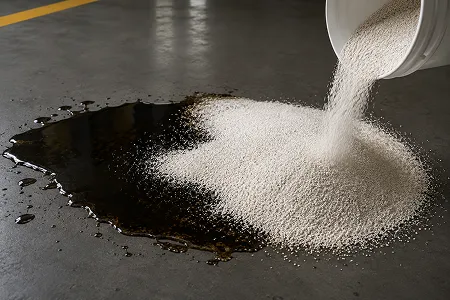
Once contained, apply the granules directly over the spill and let them work. Dwell time varies by viscosity. Thin fluids like diesel are encapsulated within a minute. Thick grease takes a little longer, two to three minutes usually. You will see the material shift from loose granules to a cohered gel mass. At that point you sweep or scoop it up, and it goes into a waste bag.
Do not try to mop it at this stage. The gelled material picks up cleanly with a scoop or broom. Mopping re-liquefies the surface and spreads contamination again.
When to Use Oil-Specific vs Universal Absorbent Granules
Oil-specific: petrochemical spills including motor oil, diesel, jet fuel, hydraulic fluid, lubricating grease, crude oil, transformer oil, and citrus-based solvents. Do not use water-based liquids.
Universal: water-based coolants, glycol, machine coolant, emulsified fluids, inks, latex paints, general industrial liquids with a pH between roughly 4 and 11. Also effective on mixed spills where you are not certain of the composition.
If you are managing a facility that handles both types, having both products in your spill kit is worth the small additional cost. Spectrum Lines GCC carries both, along with full spill kits and containment equipment for facilities across the UAE, the Middle East, and Africa.
Disposal and What the Regulations Require
This is where a lot of facilities cut corners and create a bigger problem than the original spill. Gelled super absorbent powder containing petroleum-based liquid is classified as hazardous waste. It cannot go into regular site waste. It needs a licensed hazardous waste contractor for collection and disposal.
The upside of proper super absorbent powder is that the solidified, gelled form is significantly safer and easier to transport than the original liquid spill would have been. The risk of leakage during transport is minimal. Volume is low. Documentation for disposal is straightforward. None of that is true if you tried to clean up the same spill with paper towels and a bucket.
Facilities in the UAE should verify that their disposal contractor holds the relevant licence from the environmental authority for hazardous waste handling.
Final Thoughts
Super absorbent powder does stop grease spills. The chemistry is sound, the cleanup is faster than anything else available at the point of a spill, and the disposal volume is lower than traditional alternatives. The condition is that the product matches the liquid and the application follows the right sequence.
Worth asking yourself now: does your current spill kit actually contain the right absorbent type for the liquids on your site? Most do not. Most contain whatever was cheapest or most familiar, not what is most effective for the specific spill risk the facility actually carries.
FAQ
No, and this catches people out. Oil-specific polymer powder will not absorb water-based liquids at all, because the polymer is hydrophobic by design. Universal granules work across a broader range but are not as aggressive on heavy petrochemical spills. Check the product spec against what you are likely to spill before you stock it.
Work backwards from the absorption ratio on the product data sheet. Quality oil-specific super absorbent powders absorb between 80 and 100 times their own weight in petrochemical liquids. A one-litre grease spill needs roughly 10 to 15 grams of a high-performance product. Always store more than your worst-case spill estimate because rushing to find more product mid-cleanup is not a situation you want.
Yes, for oil-specific products. The hydrophobic polymer floats and selectively absorbs the oil without taking up the water underneath. This makes it useful for spills in drain channels, small water bodies on site, and wash bays. Pair it with a containment boom around the perimeter to stop the oil from spreading before you apply the powder.
Safer than the raw spill, but still hazardous. The gel immobilizes the liquid so there is no splash risk and reduced vapor. Full PPE should still be worn during cleanup, and the collected waste has to be handled as hazardous material for disposal. Do not treat the solid form as inert just because it no longer pours.