
How to Store Chemicals Safely in Your Facility
A fusible link looks like nothing special. In some cabinet models it melts when heat builds up, and the doors close on their own to seal the contents away from the flames. Details like that sit at the center of how to store chemicals safely, and they trace back to three habits: keep incompatible products apart, contain what leaks, and keep information within reach.
Table Of Contents:
Chemical Storage Starts With Knowing What You Hold
Before anyone shops for a cabinet, list what is actually on your shelves. Flammable liquids such as fuel behave differently from corrosive acids, and different chemicals react differently to their surroundings. Choosing a chemical storage cabinet starts with that list, because a plain metal box is not a universal answer.
Volume and location come next. A few bottles in a laboratory call for a small unit, while a workshop with many drums needs far more room. Placement counts too, because a cabinet may sit inside a building or in a designated outdoor area. Good chemical storage planning settles three questions first: what, how much, and where.
How to Store Chemicals Safely by Keeping Classes Apart
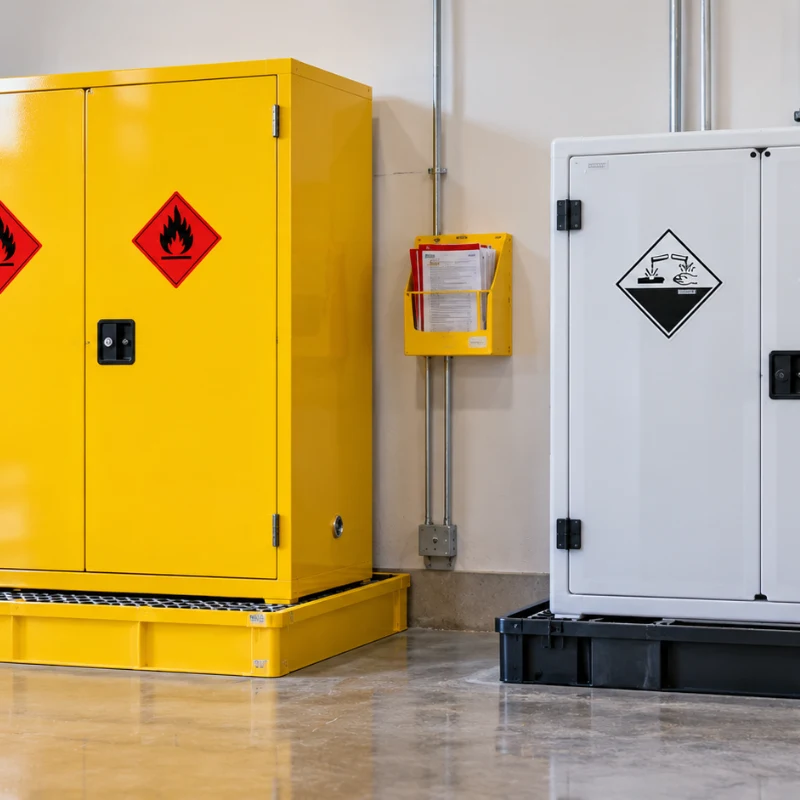
Segregation is the rule people break most often, usually by accident. Acids and flammables should never share a cabinet. Corrosive vapors can damage the fire-resistant seals on a flammable cabinet, and if a container leaks, the two products can react violently.
The practical fix is a separate cabinet for each hazard class. Flammables go in a high-visibility yellow cabinet with reinforced fire-resistant walls. Acids belong in a corrosive storage cabinet, often lined with polyethylene, since corrosive vapors would eventually eat through plain steel. Combustible liquids have their own cabinet type as well.
Used rags deserve a mention. Cloths soaked in oil, grease, paint, or solvents raise the risk of spontaneous combustion when heat builds up. Flame-resistant waste cans with self-closing lids and ventilation that disperses heat are made for that job.
Labeling and Information You Can Reach in a Hurry
Yellow is not a decoration. In a smoky room or a dim warehouse, safety yellow stands out, which helps workers and responders spot the highest-risk areas fast. Pair that with clear identification of what each cabinet holds, and you remove guesswork under pressure.
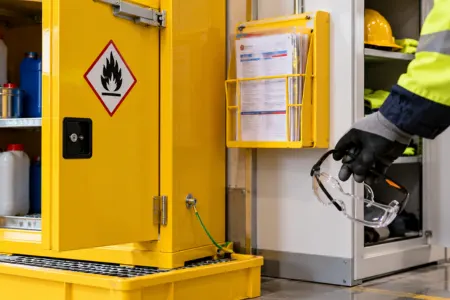
Safety data sheets belong close to the storage area. A wall-mounted MSDS box keeps them visible and protected, and weather-resistant models work indoors or out. If someone is splashed, nobody should be hunting for paperwork. What a label must say is set by your local regulator and the data sheet for each product, so check both.
Safety Cabinet Features Worth Checking
Anyone working out how to store chemicals safely at cabinet level should look past the door color. A good safety cabinet has double-wall steel construction, which helps it resist fire for longer, plus doors that close by themselves. Vents release heat and fumes. A leakproof sill, a recessed sump at the base, keeps a broken bottle’s contents inside instead of letting them reach the floor as a slip hazard.
Grounding gets overlooked. Static electricity can jump as a spark when a door opens, and a grounding wire bleeds that charge away. Whether to vent a cabinet outdoors depends on the chemicals inside. Volatile or strong-smelling products often justify it, and local environmental rules decide what may be released into the air.
Size and format matter as well. Drum storage cabinets take 200-litre drums and sit on rollers for easier movement. PPE cabinets keep helmets, gloves, and safety glasses organized beside the work area.
Standards Behind the Steel
In the UAE, NFPA (National Fire Protection Association) and OSHA guidelines are treated as a standard requirement for industrial facilities. A fire-rated cabinet is tested to hold its internal temperature for a set time while flames surround the outside. Cabinets may also be described against FM 6050, 29 CFR 1910.1450, and NFPA Code 30, depending on the model and application, so ask for the documentation instead of assuming.
This article is general information. It does not replace advice from a qualified safety officer, the data sheets for your products, or the rules of your local authority.
Final Thoughts
Safe storage is mostly a run of small decisions made before anything goes wrong. Match the cabinet to the hazard class, keep acids and flammables apart, make hazards easy to see, and put data sheets where a hand can reach them. Spectrum Lines GCC shares more on cabinet types and spill control for industrial sites in the UAE. Which shelf in your facility would worry you most if a container failed tomorrow?
FAQ
No. Corrosive vapors can damage the fire-resistant seals on a flammable cabinet, and a leak could set off a violent reaction between the two. Give each hazard class its own cabinet.
Think of it as a built-in tray at the bottom. It catches drips and spills so the liquid stays inside, away from the floor, where it becomes a slip hazard or causes environmental damage.
Visibility, mostly. Safety yellow stands out in smoke or a dim warehouse, so workers and responders can pick out the riskiest areas quickly.
It depends on what is inside. Volatile or smelly products often justify venting, but check local environmental rules about what can be released into the air before you connect anything.
Close to the storage area, where anyone can grab them in an emergency. A wall-mounted box with a weather-resistant body keeps them visible indoors or outdoors.