
Lithium Battery Fire: Why Water and CO₂ Behave Differently
A lithium battery fire does not behave like a fuel spill or an electrical short. Crews who reach for a CO₂ extinguisher out of habit often watch the flames drop, then climb right back within minutes. Water, the option most people assume is riskier around electronics, actually has the better record here, provided enough of it gets used. The difference comes down to what is happening inside the cell, not just what is burning on the outside.
Table Of Contents:
What Makes a Lithium Battery Fire Different?
The reaction inside a damaged or overcharged lithium-ion cell is called thermal runaway, and it explains almost everything about how a lithium battery fire behaves. Once a cell heats past its safe threshold, it starts releasing its own flammable gases and generating its own heat. It does not depend on outside oxygen to keep going. That single fact is why standard fire triangle logic, removing the oxygen, the fuel, or the heat, does not apply the way it does to a wood fire or a fuel spill. Adjacent cells in the same pack absorb that heat and follow the same path. The U.S. Fire Administration has documented this cascade pattern in its guidance for fire departments responding to lithium-ion incidents, noting that a pack can restart hours after everything looks calm. This is the mechanism behind reignition risk, and it is why a battery fire gets treated as a structural hazard long after the flames appear to be out.
Why CO₂ Knocks Down Flames But Doesn't Finish the Job
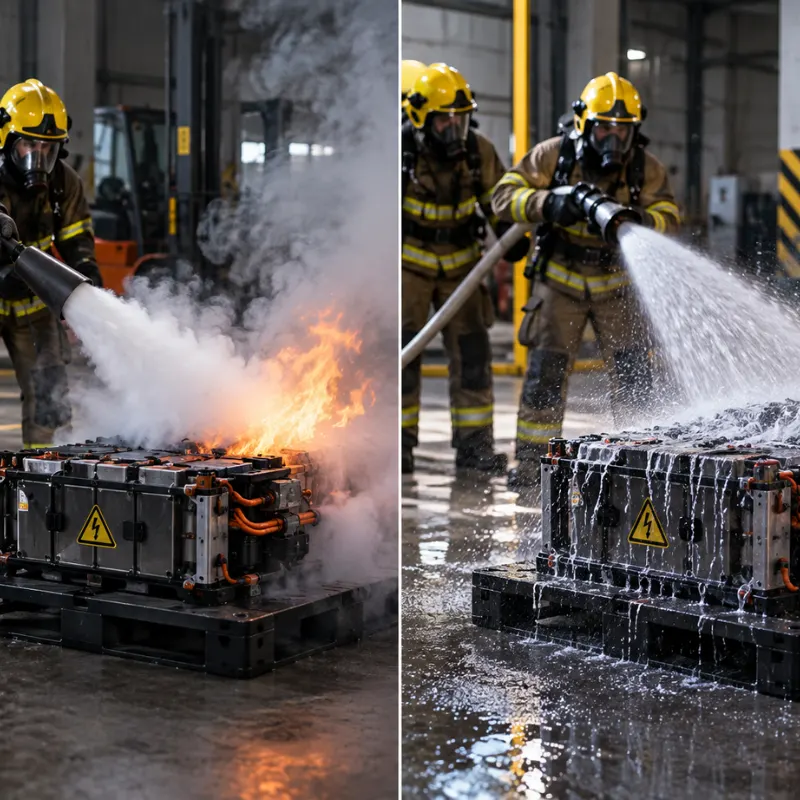
CO₂ works by displacing oxygen around a fire, which is exactly the right approach for a fuel spill or an energized electrical panel. Point it at a burning battery pack, and the visible flames usually drop within seconds. The trouble sits underneath the surface. Thermal runaway does not depend on the oxygen in the surrounding air, so pulling that oxygen away does nothing to the heat still building inside the cells. Crews who treat a flame knockdown as full extinguishment have walked away from packs that reignited later in the same shift, sometimes after the scene had already been cleared. CO₂ still has a place in a response plan, mainly for buying a few minutes to reposition equipment or protect an exit route, but it was never built to interrupt thermal runaway once it has started.
Why Water Works, Given Enough of It
Water’s advantage comes down to something fairly simple. It absorbs far more heat per gram than CO₂ does before it changes state, so it pulls thermal energy out of a burning pack instead of just smothering the flame sitting on top of it. That cooling effect is what eventually slows and stops thermal runaway from spreading cell to cell. The catch is volume. Research on lithium-ion pack fires points to a rough figure of 300 to 700 liters of water for every kilowatt-hour of battery capacity involved, and a pack can still exhibit thermal runaway for up to 72 hours after the fire looks extinguished. That is a lot of water and a long monitoring window for one incident, which is why fire response guidance now treats a battery fire as an extended event rather than something closed out by the end of a shift.
Building a Response Plan Around Cooling, Not Knockdown
A site that stores or charges lithium-ion packs needs a plan built on that reality rather than on the assumption that a fire extinguisher settles the matter. That means access to a sustained water source, not just a handheld extinguisher, and a quarantine area where a pack involved in a fire, or even just dropped or damaged, can sit under observation for at least a day before anyone assumes it is safe. Self-contained breathing apparatus matters too, since thermal runaway releases hydrogen fluoride and other dangerous gases well before flames are visible. None of this replaces a proper site fire risk assessment carried out with a safety officer, but it shapes what that assessment needs to cover.
Charging and Storage Areas Are Where the Risk Starts
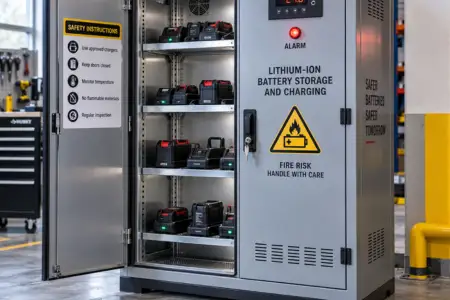
Most incidents involving a lithium battery fire do not start during use. They start during charging, often overnight in a workshop or warehouse corner where packs sit on an open shelf with a charger left running and nobody on the floor to notice a problem. That gap is what a lithium battery storage cabinet is built to address, not by suppressing a fire once it starts, but by catching the early signs before thermal runaway gets that far. Continuous temperature monitoring, interior smoke detection, an audible and visual alarm, and an emergency stop function as supporting controls rather than a suppression system, and any facility installing one still needs to confirm placement against its own fire strategy and UAE Civil Defence requirements before installation. Lockable doors and adjustable shelving solve a separate problem: they stop charging bays from being shared informally across a shift, which is often how a damaged or mismatched pack ends up charging unsupervised in the first place.
Final Thoughts
None of this makes lithium-ion batteries unsafe to use. It means the response plan has to be built around cooling and containment rather than a quick knockdown, and the storage and charging setup on site has to reflect that reality from the start rather than after an incident forces the question. Spectrum Lines GCC supplies the storage cabinets referenced above to sites working through exactly this kind of planning, though the cabinet is only one piece of a wider fire strategy. Where is your site charging its packs right now, and would that setup catch a problem before it spreads?
FAQ
CO₂ removes oxygen from the air around a fire, which works on fuel and electrical fires but does nothing to the heat building inside a battery cell. Thermal runaway generates its own oxygen and fuel, so the flames can drop for a moment and then reignite once the extinguisher's effect wears off.
Numbers from lithium-ion fire testing put the figure at roughly 300 to 700 liters per kilowatt-hour of battery capacity involved. Small consumer devices need far less, sometimes just a bucket, but a larger pack or an energy storage unit can call for a sustained water supply over an extended period.
Yes, and this is one of the more dangerous parts of the process. Damaged cells can sit below their ignition point for hours or even days before heat builds back up enough to restart thermal runaway. Quarantine and monitoring after any suspected battery fire matters as much as the initial response.
A cell that is overcharged, physically damaged, or manufactured with a defect starts heating uncontrollably and venting flammable gas. That heat spreads to neighboring cells inside the same pack, which repeat the process. The reaction feeds itself rather than depending on outside air, which is what makes it hard to interrupt.
No, and it isn't designed to. A cabinet with temperature monitoring, smoke detection, and an emergency stop gives an early warning and a way to cut power fast, but it works alongside a site fire strategy rather than replacing one. Placement and civil defence approval still need separate sign-off.