
Drum Handling Trolley: Choosing the Right Type
A drum handling trolley works differently depending on what it’s carrying and where it’s carrying it. At sites in Sharjah’s Al Sajaa Industrial area, drums move constantly between chemical storage, oil handling stations, and warehouse floors, and that movement carries risk on two fronts: a heavy drum straining a worker’s back and a leaking one leaving a trail across the concrete.
Table Of Contents:
What Does a Drum Trolley Actually Built to Do?
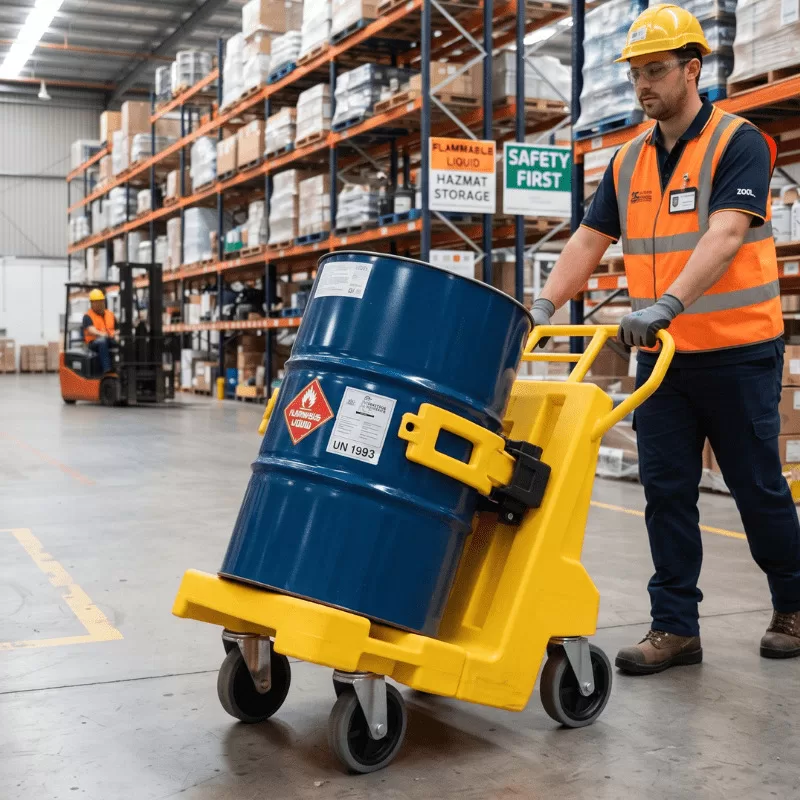
The core job of any drum handling trolley is straightforward. It replaces manual rolling or dragging with a wheeled base and a handle, so a 200-liter steel or plastic drum can move without a worker bearing its weight directly. The drum Trolley is built around that principle, with a spill containment basin under the drum position and smooth-rolling casters for tight warehouse aisles.
That containment element matters more than it sounds. A drum trolley that only moves the drum still leaves cleanup as someone else’s problem. One built with a spill basin catches what drips out mid-transport, which is the difference between a routine shift and an unplanned floor cleanup involving hazardous liquid.
The Poly Drum Trolley: A Sump Built Into the Base
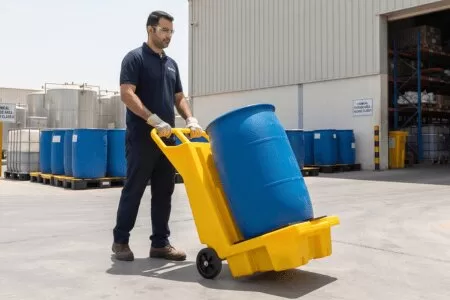
Where the standard unit uses a containment basin, the Poly Drum Trolley goes further with a 20-liter spill sump molded into a polyethylene base. The material choice isn’t cosmetic. Steel corrodes when it sits in repeated contact with solvents or chemical residue. Polyethylene doesn’t, which is why sites running chemical storage or oil handling day after day tend to outlast a steel equivalent with this build.
The specs back up the outdoor use case too. It carries a 240 kg static load and a 200 kg dynamic load, comfortably inside the range of a full 200-liter drum, and measures 1120 x 770 x 770 mm at a gross weight of 9.5 kg. It’s forklift compatible for sites that already load drums that way, and a built-in drain plug means the sump empties in seconds rather than requiring a tip-and-mop routine. UV and corrosion resistance let it sit in a yard through direct sun without cracking or fading, which is relevant for facilities that don’t have the luxury of indoor-only storage.
Matching the Trolley to What's Actually on the Floor
Picking between trolley types comes down to a few practical questions rather than brand preference. If a site handles general oil drums indoors with occasional spill risk, the standard drum trolley with its containment basin and ergonomic handle covers that use case. If the operation involves chemical storage, solvent handling, or drums that sit outdoors in Gulf summer heat, the polyethylene build earns its keep through corrosion resistance and the larger built-in sump.
Forklift access is another deciding factor. A site already running forklift-based loading benefits from a trolley designed for that handoff, cutting out extra manual steps between racking and floor transport. A facility without forklift infrastructure will lean more on the manual maneuverability of casters and handle design instead.
Where Equipment Choices Meet Safety Compliance
Drum handling sits inside a broader safety obligation, not just an operational convenience. In the US, OSHA’s general materials handling standard, 29 CFR 1910.176, requires that stored and moved materials be handled in a way that doesn’t create a stability or storage hazard, a principle that applies just as much to how a facility approaches drum movement day to day. A full 200-liter drum is heavy enough that manual handling alone carries real strain risk, which is exactly the gap mechanical aids like a drum trolley are meant to close.
Facilities running multiple hazard classes often pair a drum trolley with complementary equipment such as drum spill pallets for static storage or absorbent kits for reactive cleanup, since a trolley addresses transport risk but not long-term storage containment. Reviewing the Safety Data Sheet for whatever substance is being moved remains a separate step that equipment alone doesn’t replace.
Final Thoughts
The right drum handling trolley depends less on which one looks sturdier and more on what’s actually moving through a facility, in what quantity, and under what weather conditions. A site weighing chemical exposure, outdoor storage, or forklift integration has a fairly clear answer once those factors are laid out. What does your current drum handling setup struggle with most; leaks, manual strain, or outdoor durability?
FAQ
Standard units are built around 200-liter, or 55-gallon, drums, both steel and plastic. That's the size most chemical storage, oil handling, and manufacturing sites already run, so compatibility usually isn't the deciding factor.
Both, depending on the model. The base drum trolley includes a spill containment basin, while the poly version adds a 20-liter sump built right into the platform, catching leaks before they reach the floor during transport.
The polyethylene version can. UV resistance and corrosion resistance are the two properties that let it sit in a yard through direct sun and heat without cracking, fading, or breaking down the way an untreated steel unit might.
No. Forklift compatibility on the poly version is an option for sites that already load that way, not a requirement. Ergonomic handles and swivel casters allow fully manual operation for facilities without forklift access.
Specifications list a 240 kg static load capacity and 200 kg dynamic load capacity. A fully loaded 200-liter drum sits within that range, so weight isn't usually the limiting factor for standard drum sizes.