
The Future of Industrial Safety: Emerging Trends and Technologies
Table Of Contents:
What is Industrial Safety?
For people who work in the industrial sector ensuring safety is a crucial requirement. Industrial safety is a set of policies, practices guidelines and standards that safeguard both personnel and machinery. Its main goal is to reduce accidents and injuries in the workplace.
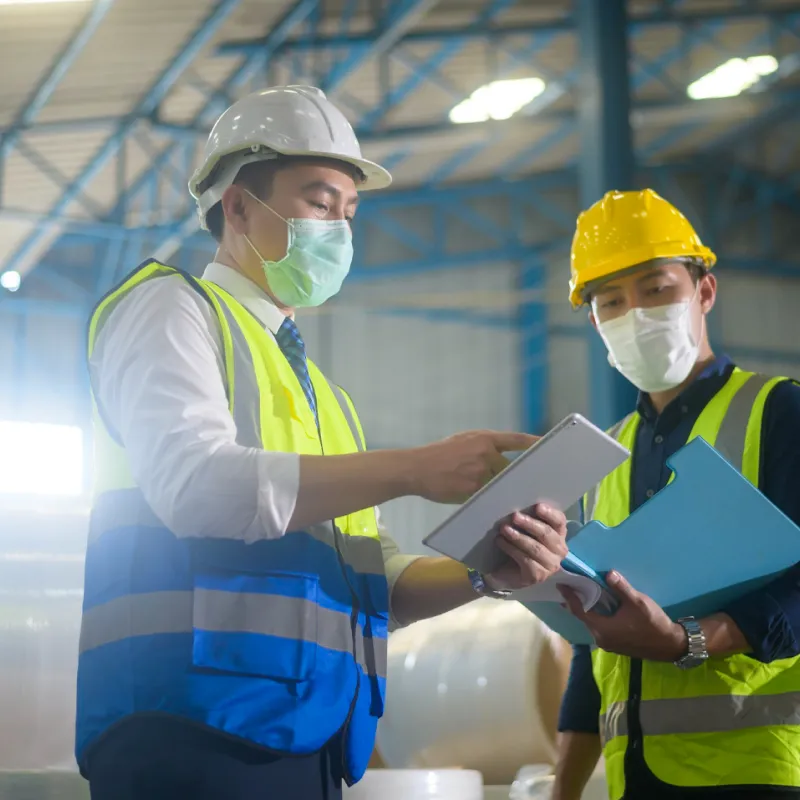
Why Safety is Necessary in Industry?
- Providing workers with safety from accidents is of utmost importance. Safe workplaces reduce fatalities.
- When using chemicals and machinery accidents are possible. Safety precautions lessen the likelihood of mishaps and injuries.
- Workers work more effectively when working in a safe environment. Fewer accidents result in higher productivity.
- Accidents can result in significant losses including the need to pay for workers medical expenses or equipment or machinery.
- Complying with industrial safety laws helps a company avoid legal problems. Maintaining safety prevents these financial losses.
Emerging Trends And Technologies
Safety Training with Virtual Reality (VR):
One of the technologies that is raising the bar for industrial safety is virtual reality (VR). Unlike traditional training VR helps employees to familiarize themselves with potential hazards without actually experiencing them. Experiencing potential hazards in a safe virtual world enhances the quality of training.
Important advantages of VR training:
- Through virtual reality workers can directly experience emergency situations, dangerous locations and mechanized operations.
- Workers don’t have to worry about actual risks while learning useful safety techniques.
- When repeatedly trained in VR simulations employees gain confidence to act quickly in emergency situations.
- Because large equipment spaces and safety precautions are not required, training expenses are decreased.
- VR systems track each employee’s reaction time decisions and errors and help them improve individually.
Safety Monitoring in Real Time and the Internet of Things (IoT):
One of the biggest challenges in industrial operations is to identify and respond quickly to potential hazards. The Internet of Things (IoT) is turning into a great way to monitor safety in real time. Comprehensive data about machines equipment worker movements and environmental conditions is collected instantly by IoT sensors. Through this data processing it is possible to identify potential hazards before they emerge and take safety measures quickly.
Key benefits of real-time safety monitoring:
- The system will send out an alert right away if the machine or environment undergoes any unusual changes. This can help prevent accidents.
- Safety protection never stops because IoT sensors are constantly in operation. data-driven choices about safety.
- The collected data can be used to analyze potential hazards and formulate more effective safety protocols.
- By being able to identify machine failures in advance downtime is reduced and productivity is increased.
Wearable Technology for Worker Safety:
Ensuring the safety of workers in the industrial sector is a major challenge. Wearable technology is one of the key technologies that today’s industries are adopting to make it more efficient. Safety is being raised to new levels by this technology which uses wearable sensor devices to monitor workers health location activities and risks.
Key benefits of wearable technology:
- In order to address health issues early management has real-time access to data such as body temperature, heart rate and fatigue.
- Alerts are received when entering hazardous areas so that precautionary measures can be taken quickly.
- The system will immediately warn in situations such as worker falls, loss of consciousness and slips.
- Wearable technology makes it possible for employees to be restricted to specific locations. Improving safety through data analysis.
Human-Machine Collaboration for Safety:
With the modernization of the industrial sector the system in which humans and machines work together is rapidly growing. The bar for safety is raised when human judgment and machine precision are combined.
This is an effective method of raising safety standards and lowering workplace accidents.
Key safety benefits of human–machine collaboration:
- When robots perform tasks involving high temperatures, toxic gases and heavy machinery the safety of workers can be ensured.
- When the data analysis capabilities of machines and the experience of humans are combined it is possible to accurately identify potential hazards.
- The support of machines helps to avoid errors that occur due to fatigue in humans.
- Machines use AI-based systems and sensors to quickly identify warning signs. Humans are given time and support to observe and respond to them.
- Safety procedures are continuously becoming better and more effective as worker-machine synergy grows.
Data-driven Safety Optimization Decision Making:
Industries have started to make safety decisions accurately and proactively using large amounts of information collected through machines, sensors, worker actions, and environmental conditions. The idea behind data-driven safety optimization is this. Moving away from the method based on years of experience or observation, safety protocols are now formulated with the support of all data and analytics.
Key benefits of data-driven safety management:
- Data analytics can reveal patterns and behaviors that were previously overlooked. This allows for the taking of action prior to an accident.
- Instead of relying solely on human intuition it is possible to formulate safety measures using accurate data and reports.
- Safety procedures can be improved and updated on a regular basis because data analysis is ongoing.
- Data reveals which employees are more vulnerable and where mistakes are most common.
Psychological Safety and Well-being in the Workplace:
When it comes to safety in industries the focus is often on machinery and physical hazards. However in today’s workplace psychological safety and the overall well-being of workers play a major role in determining workplace safety. Psychological safety is an environment where a worker can speak up, share decisions and concerns and work without fear. Such a workplace not only boosts the confidence and performance of workers but also reduces dangerous errors and increases efficiency.
Key benefits of psychological safety:
- They can work without fear of pointing out mistakes and reporting potential hazards.
- As trust grows communication improves and the ability to solve problems together increases.
- As dangerous errors are reported promptly rather than slowly forgetting the risk of accidents decreases.
- Workers are encouraged to present innovative ideas without fear of criticism.
Safety Culture and Leadership:
Safety culture is the most important factor in industrial safety surpassing machinery technology and training. Safety culture is the combination of an organization’s approach to prioritizing safety in its daily routines and the tendency for it to be continuously reflected in employee behavior decision-making and communication. What strengthens this is leadership. The more seriously an organization’s leaders take safety the more it becomes a routine for employees.
Key elements of safety culture:
- Safety is not just the job of management, every employee must recognize their role.
- A safe environment where there is no fear of reporting hazards and sharing concerns strengthens safety.
- Progress starts with a culture that views errors and near-misses as teaching moments rather than as something to be avoided.
- Understanding evolving technology and safety procedures requires ongoing training.
Sustainability and Environmental Safety:
In today’s industrial world it is often not enough to associate safety alone with the well-being of workers.
The main reason is to maintain sustainability and environmental safety:
- Nature can be protected by proper storage of chemicals, waste management and not polluting water and air.
- Operating costs can be reduced through practical methods such as organic reductions in solar power and energy-efficient machinery while providing safety to the environment.
- Complying with environmental laws avoids legal problems and gives a good reputation to the company.
- By securing the environment we can provide a safe and healthy environment for workers and the community.
- Waste reduction energy efficiency and legal compliance give businesses stability and financial gains.
FAQ
Sustainability and environmental safety together form the basis for the long-term growth and social responsibility of companies. Protecting the environment and conducting operations sustainably over the long term are the main goals.
Safe storage of chemicals, waste management and energy-efficient machinery help reduce accidents and pollution in the operational areas.
Financial success over the long run. Ensuring regulatory compliance. increased credibility of the brand. A safe environment for workers and the community.